R.G. Davis
Mentor, theater visionary, and pain in the ass

R.G. Davis, founder of the San Francisco Mime Troupe departed this life on the summer solstice. Ronnie was — and is — my mentor, my pal, my leader, my father, my open door, my pain in the ass,


one pole of my universe, my life changer, my favorite sonofabitch.
At the dawn of the 1960s, Ronnie launched a radical theater vision that would warp the American theater scene for decades by getting busted for performing in a San Francisco municipal park without a permit. R.G. wanted to stage high-quality radical theater in the parks, no strings attached — no corporate sponsorship, no foundation grants, no city money. He wanted to talk about racism, class warfare, and the bullshit scourge of McCarthy’s anticommunism.
R.G. Davis and a fledgling theater company called the San Francisco Mime Troupe brought its own powerful new approach emerged into this scene. Ronnie brought a European approach to the work, drawing on the influences of Bertolt Brecht, the musician Hans Eisler. He also brought an old theater form back to life — commedia dell’arte, a bawdy, class-conscious form of street theater that peaked in the 16th century in Europe. Shakespeare borrowed from commedia, as did Moliere and many others.
R.G. saw that, like the marketplace of old European cities, the San Francisco parks were ideal performance spaces. We built portable stages that fit into the back of a flat bed truck, show up on a grassy stretch of park land, leaving plenty of room for an audience to gather and watch the show… for free.
Commedia was ideal for out of doors. Each performer wore a mask that represented stereotypes — what class, what personality traits — explained what kind of character he or she was. There were poor characters: soldiers, fools, clever servant girls, rich old merchants, pompous doctors, hustlers, musicians. The characters were broad, bawdy, and farcical, and R.G. knew that they would serve well to talk about racism, sexism, modern imperialism, capitalism’s ripoff.
But before he could perform in the parks, R.G. knew he would have to force the issue. Even in San Francisco, the straight world sought to diminish the “threat” looming from politicians, educators, and artists seeking to express their understanding that WW II had changed the world and that the Cold War was turning the country into a profiteering war machine. Veterans had returned as changed people after the war they fought, killed, and died in. Women had lost their financial independence after the war industries closed down and women were forced out of lucrative jobs and into Ozzie and Harriet relationships.
By the mid-50s, communism, anarchy, interracial mixing, and sexual “obscenity” fell into the same verboten category. Even in the 1950s, straight San Francisco had been shaken by the funky, fruitful beat scene that explored the departure from straight, gray-flannel, housewife-trapped, consumer-worshipping post-war blah. The beat scene was defined by the press as degenerate, marijuana-ridden, promiscuous, and immoral.
The much-beloved San Francisco columnist Herb Caen was typical as a leader in the anti-radical threat movement. He labeled activists of the alternative art and culture movement “Beatniks.” The term created a clever bit of mini-propaganda by putting a Russian/Soviet “nik,” e.g., the high-profile Soviet satellite named “sputnik,” “bolshevik” as a final syllable, linking the bohemian and beat culture to Russian, i.e., communist cultures. So the beats became known “beatniks,” i.e., communists.
The parks, like other municipal property became subject to the censorship of a conservative city council, a reactionary Republican mayor, and the heavily biased media who joined the anti-communist, creeping socialist choir to propagandize for a freeway system, to rant against federally subsidized housing, public health care, and to editorialize against the burgeoning hip cultural scene as immoral, obscene, and communistic.
Certainly the bawdy performances of a troupe that changed into revealing costumes outdoor and presented suggestive free shows in the parks needed to be stopped. They refused to issue park permits to R.G. and his fledgling performers. This cultural/political tug of war continued while the Mime Troupe continued to grow.
So, on a foggy San Francisco morning, R.G. showed up in the parks with an entourage of friends, associates, and a lawyer or two, donned a commedia costume and put on a show that attracted a crowd of citizens and — of course, the police and the media. As planned, R.G. was arrested.
A media barrage, court case, and the First Amendment ensued, and R.G. Davis and the San Francisco Mime Troupe played free in the parks and toured the country and the world, performing high-quality, hilarious theater from that point on.
I joined the Troupe in 1966 but, when R.G. found out I was abandoning my final year of undergraduate studies, the following discussion ensued:*
R.G. was booking a tour of the Northwest with the Minstrel Show and a commedia show. After that, they were headed for New York to perform at Town Hall with Dick Gregory! I didn’t dare hope, but R.G. might cast me in the commedia. And with my music chops, I was good for the Minstrel Show. But I hadn’t told R.G. that I had another year to finish back at Harvard. When he found out, R.G. dragged me into the office. “Go finish school,” he said.
I found it weird that this radical anarchist was so adamant about a college degree. “Isn’t this the thing to do?” I said. “You know… turn on, tune in, and drop out?”
“Bullshit,” R.G. said. “That’s Timothy Leary’s crap. Drop out and you disappear. That’s for fucking pop stars, and they don’t drop out. They plug in and sell out. Turning on is irrelevant. Get high, don’t get high, I don’t care, just be on time, know why you’re here, and don’t forget the ammunition.”
He walked me to the bottom of the stairs. Nobody else was around. “We commit,” he said. “We engage. We breathe the fresh air of the parks and put on free shows. We create the path of most resistance. We fight the system.”
“I know,” I said. “That’s why I want to work with you guys. Didn’t you give me a part in the Minstrel Show? You know I can play the music! You know I can act. What good is a diploma from the belly of the beast? It’ll just give me gas.”
“It’s a weapon,” he said. “You run a candy store, you’re a part of capitalism. You run a theater company, you run a candy store. We swim in a capitalist sea. Like it or not, we breathe the air of your beast’s belly. You learn how to think, you can tell the difference between what is and what can be.”
“Even you guys?” I asked. “You’re not capitalists, for chrissakes. You’re political artists.”
“We own the means of production. We don’t own the housing, we don’t own the food, we don’t make clothing, and we drive vehicles and burn gas.”
I’d never thought of it that way.
“And most important,” R.G. said, “We don’t own the means of distribution. We’ve got to hustle our own theater from whatever raggedy-assed network the Left has cobbled together.” He paused and grinned. “Got a solution to that?”
“No,” I said. “But I’m gonna burn a lot of gas humping it back to Cambridge.”
He opened the studio door. “Drop out and you’ll be good for nothing but smoking dope and playing guitars. We got plenty of that. We need certified, bona fide smarties with a license to think. You’re already a smarty. Bordering on a smart-ass. Get your diploma, and you’ll have your papers in order.”
R.G. pulled me out the door, shoved me into my station wagon, and put an arm on my shoulder. “You’re good at this. But for now…” He stepped away from the car. “Beat it. Maybe we’ll see you next year.”
He did see me next year. And the next. And the next. He and the San Francisco Mime Troupe gave purpose and direction to my life that I still follow to this day. I met Ronnie 60 years ago. It will take the rest of my lifetime to fully absorb Ronnie’s influence on me, the political theater scene, and now his departure. The death of a man, the and of an era.
Commitment, Engagement & Fresh Air, baby! ❤️
# # #
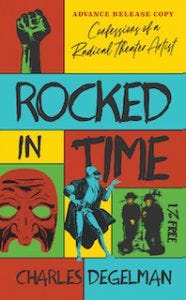
* The final conversation between R.G. and me was excerpted from Rocked in Time, Vol III of my Resistance Trilogy, but close enough to the truth. — cd